
 |
 |
 |
 |
 |
 |
 |
 |
 Focus
Focus
The US government is actively promoting cryptocurrencies, especially stablecoins, which are digital assets backed by a reference currency. This strategy goes beyond the national financial framework; it aims to consolidate the global dominance of the dollar and reshape the international monetary order. By favoring dollar-backed stablecoins, the United States hopes to strengthen the influence of its tech giants in payments, and boost demand for dollar-denominated assets, particularly its public debt. The Genius Act provides the legal basis for this approach, in contrast to the European Markets in Crypto-Assets Regulation (MiCAR), which favors consumer protection over the financial risks of stablecoins. The US policy could weaken the efforts of the European Central Bank (ECB) to increase the international role of the euro, and threatens the monetary sovereignty of many countries. To avoid this, the EU would benefit, along with its partners, from defending a multilateral payment system based on cooperation. Éric Monnet
>>> |

This discussion on the latest issue of the IMF’s World Economic Outlook explores how rising geopolitical tensions are reshaping the global economy, driven by a surge in defense spending and actual conflicts. While the increase in defense spending can boost economic activity in the short term - depending on how it is sustained, financed, allocated, and on the share of imported equipment - it comes with significant trade-offs. These include higher fiscal deficits, rising debt, inflationary pressures, and risks to social spending and external balances. Conflicts, when they materialise, lead to large and persistent output losses that spill over across countries, while post-conflict recoveries tend to be slow and fragile. The presentations made by Andrea Filippo Presbitero (IMF) and Alain Quinet (Académie de Saint-Cyr Coëtquidan, IHEDN) are available online.
>>> |
 publications

- Military Alliances: A Major Commercial Stake
Matteo Neri-Lainé - United States: The Security Paradox of Trade Decoupling from China
Thierry Mayer, Isabelle Méjean, Mathias Thoening - Characterizing Geopolitical Relationships to Better Understand Trade
Nathan Chevalier, Matthieu Crozet, Charlotte Emlinger, Daniel Mirza

- Energy Economics
Greening the implementation of the African Continental Free Trade Area Agreement
Lionel Fontagné , Stephen Karingi , Simon Mevel, Cristina Mitaritonna, Yu Zheng
Presentation of the CEPII's and the OFCE's annual publications "The French Economy 2027", "The European Economy 2027" and "The World Economy 2027"
September 9, 2026
Facts & Figures >>> |
The United States: The Security Paradox of Trade Decoupling from China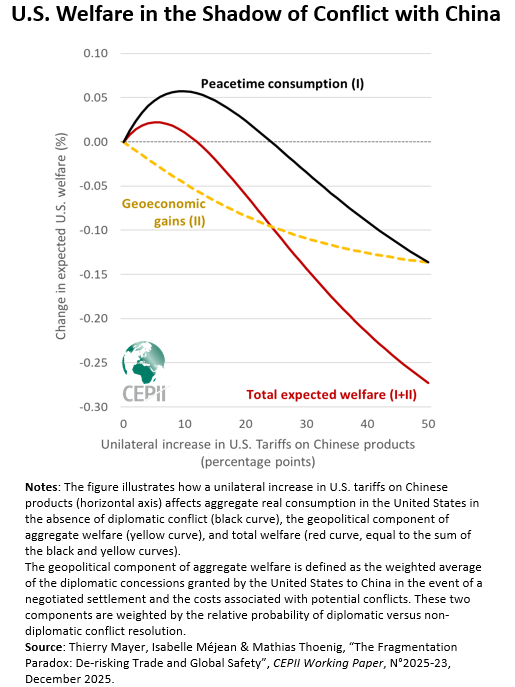 The growing dependence of the United States on Chinese goods has increased the economic cost of geopolitical disputes with China for the U.S. economy. The United States therefore faces a fundamental security dilemma: while decoupling may strengthen its diplomatic bargaining power, it may also fuel a costly escalation of tensions. Thierry Mayer, Isabelle Méjean, Mathias Thoening >>> |
To Stay Informed

- Contact us
- Our other sites
 |
 |
 |
ISSN: 1255-7072
Editorial Director : Antoine BouëtManaging Editor : Evgenia Korotkova