
 |
 |
 |
 |
 |
 |
 |
 |
 Focus
Focus
International insecurity can severely disrupt trade. This Working Paper studies treaties aimed at preventing such insecurity: military alliances. The author develops a quantitative model of trade with endogenous international insecurity, where alliances affect trade flows by reducing the risk of violent expropriation faced by firms. Taking a structural gravity approach, he shows that alliances increase trade by 66% on average. The effects of military alliances are dynamic and heterogeneous. They depend to a large extent on the type of alliance and the economic size of partners. An instrumental variable strategy and an event study confirm the causal interpretation of the results. Investigating the mechanism behind the impacts of military alliances, the paper demonstrates that alliances increase trade by reducing international insecurity. Moreover, employing the full scope of our theoretical model, a general equilibrium analysis shows that the growth in trade generated by military alliances brings substantial welfare gains for signatories and losses for non-aligned countries. Matteo Neri-Lainé
>>> |
This recent Working Paper introduces a base-peak load structure to electricity modeling in large-scale CGE models to better capture merit order dispatch, capacity constraints and renewable intermittency. A transparent toy model demonstrates how ignoring peak load constraints systematically underestimates the macroeconomic impacts of energy shocks.The authors argue that second-order approximation are not well-suited for this kind of exercise, due to the large size of the shock compared to the value of the elasticity of substitution. The authors treat base load and peak load electricity as non-substitutable Leontief complements, reflecting operational constraints in electricity systems. Applying the refined model to the 2022 Russian gas shock reveals larger GDP and welfare losses in Germany and the EU than standard electricity representations predict. Balthazar de Vaulchier, Lionel Fontagné, Yu Zheng
>>> |
 publications

- Characterizing Geopolitical Relationships to Better Understand Trade
Nathan Chevalier, Matthieu Crozet, Charlotte Emlinger, Daniel Mirza - Economic Integration of Non-European Immigrants: Difficulties That Ease Over Time
Anthony Edo, Jérôme Valette

- Sovereign Gravity: The Military Alliance Effect on Trade
Matteo Neri-Lainé - Air Service Agreements, Connectivity and Emissions
Lionel Fontagné, Cristina Mitaritonna, Gianluca Orefice, Gianluca Santoni - What if? Revisiting the Macroeconomic Impact of the Energy Crisis with Peak-load Electricity
Balthazar de Vaulchier, Lionel Fontagné, Yu Zheng - Trade under Tensions: Insights from Media-Reported Bilateral Events
Nathan Chevalier, Matthieu Crozet, Charlotte Emlinger, Daniel Mirza - MIRAGE Model Documentation Version 2.0
Antoine Bouët, Lionel Fontagné, Christophe Gouel, Houssein Guimbard, Cristina Mitaritonna, Balthazar de Vaulchier, Yu Zheng
IMF's World Economic Outlook 2026:
The Economic Consequences of a Conflict-Prone World
May 5, 2026
Presentation of the CEPII's and the OFCE's annual publications "The French Economy 2027", "The European Economy 2027" and "The World Economy 2027"
September 9, 2026
The investment and broader macroeconomic impacts of the EU’s energy transition. Discussion with Romain Duval (IMF)
Download the presentation

- The nightmare scenario for global trade
The Economist
CEPII, BACI Database
Facts & Figures >>> |
Characterizing Geopolitical Relationships to Better Understand Trade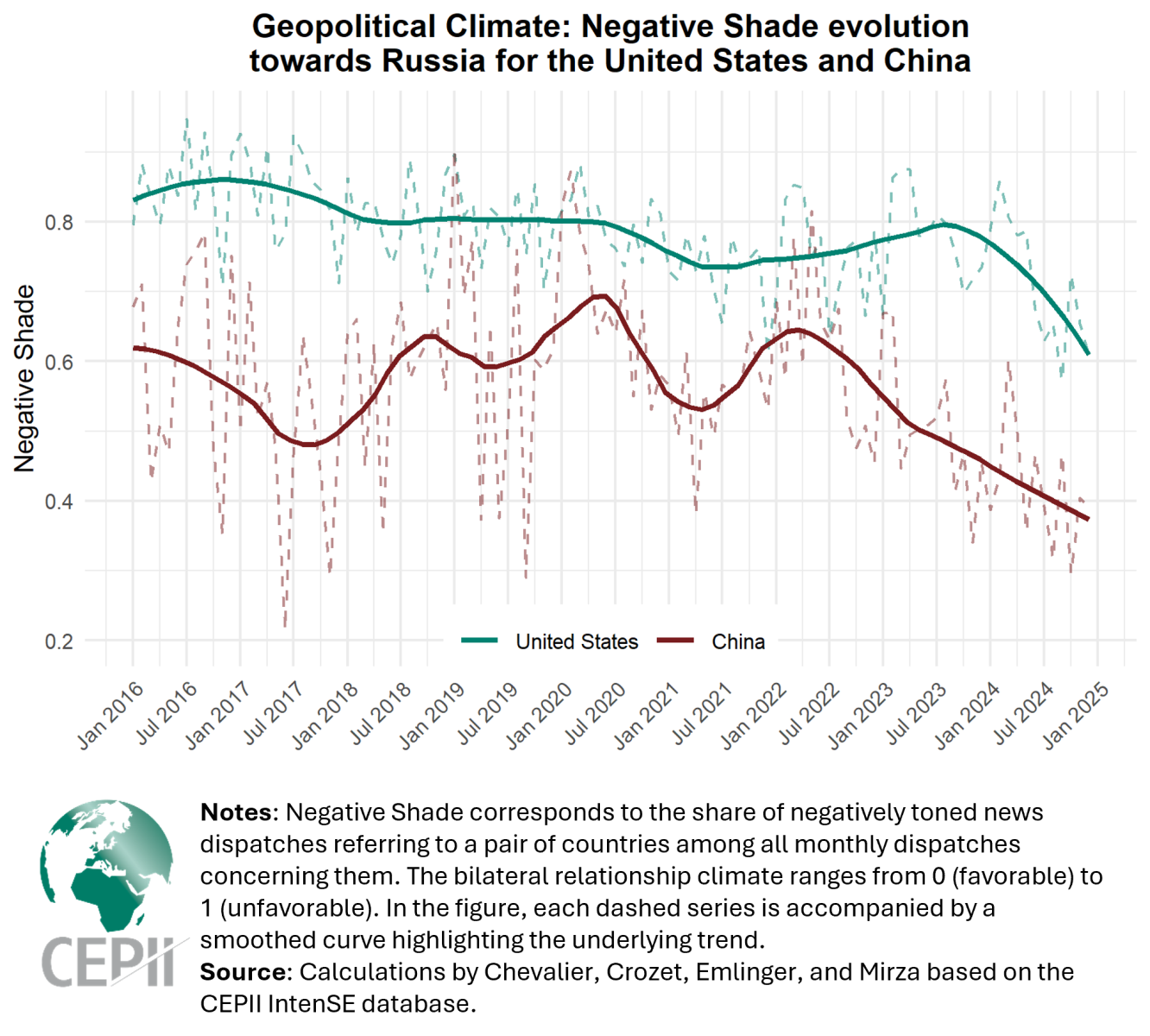 The markedly negative tone of relations with Russia has eased for the American and Chinese superpowers, according to the geopolitical climate indicator "Shade". Nathan Chevalier, Matthieu Crozet, Charlotte Emlinger, Daniel Mirza >>> |
Economic Integration of Non-European Immigrants: Difficulties That Ease Over Time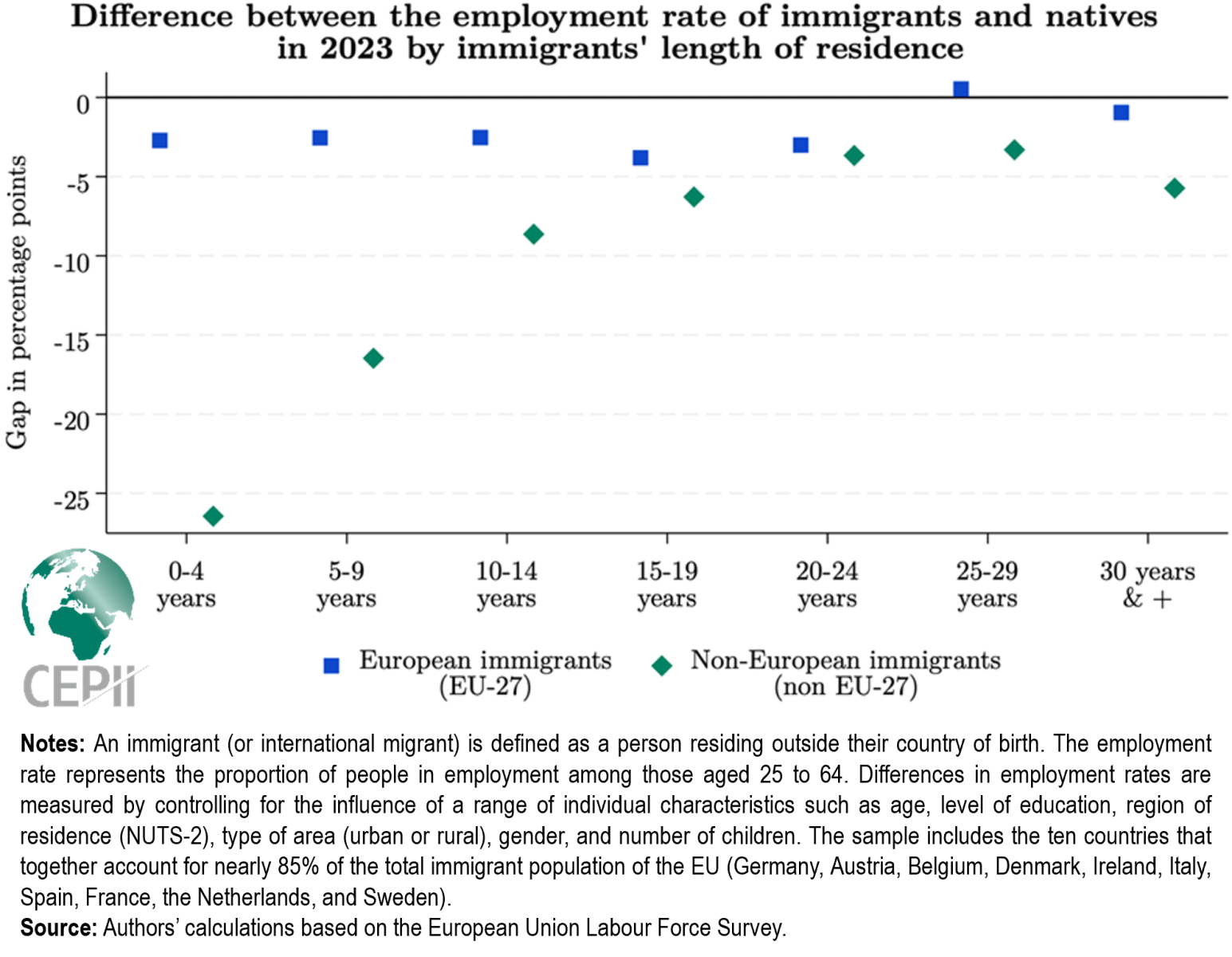 Within the ten main host countries of the European Union (EU), non-European immigrants (born outside the EU) face notable difficulties in economic integration. With comparable socio-economic characteristics, their employment rate is on average 11 percentage points lower than that of native-born individuals. Anthony Edo, Jérôme Valette >>> |
To Stay Informed

- Contact us
- Our other sites
 |
 |
 |
ISSN: 1255-7072
Editorial Director : Antoine BouëtManaging Editor : Evgenia Korotkova