
 |
 |
 |
 |
 |
 |
 |
 |
 Focus
Focus
The current narrative portrays modern services – such as financial, digital, and business services – as the new engine of globalization, sustaining global trade openness despite shocks like the pandemic, geopolitical tensions, and protectionist policies. This Policy Brief qualifies this view by showing the outsized role of tax havens, which now account for over 25% of global modern services trade (up from 12% in the late 1990s), far exceeding their 4% share of global GDP. Multinational enterprises’ tax avoidance strategies may inflate recorded trade flows of modern services, particularly in tax havens. A back-of-the-envelope calculation shows that the growth of modern services trade is 25% larger when including trade with tax havens over 2005–2022, and 35% larger over 2005–2019, highlighting their disproportionate impact on globalization metrics. Simon Keller, Vincent Vicard
>>> |
Between January 2025 and March 2026, the U.S. average applied tariff rose sharply, reaching more than 15% by March 2026. Under sustained policy uncertainty, the legally durable instruments, such as Section 232, captured a rising share of aggregate protection and came to dominate the residual structure once the emergency IEEPA layer was removed. A counterfactual general-equilibrium analysis indicates that a legally durable Section 301 regime could approximate the tariff regime in force in November 2025, on the reindustrialisation objective, without recourse to legally fragile emergency instruments. The resulting gains in manufacturing value added reflect a sectoral reallocation achieved at an aggregate cost — U.S. GDP declines — while the cross-country incidence is governed as much by instrument design as by the average tariff level. Houssein Guimbard
>>> |
This Working Paper investigates the historical determinants of real mineral commodity prices using a structurally identified vector autoregression (SVAR) with incomplete identification. Drawing on a large sample of mineral commodities covering more than a century of data, the authors identify supply, aggregate demand, and metal-specific demand shocks using economically motivated prior distributions. Historical decompositions show that price fluctuations are predominantly driven by demand-side forces, with metal-specific demand shocks accounting for the largest share of variation. Aggregate demand shocks also play an important role, particularly during periods of global instability, while the contribution of supply shocks is more limited and tends to decline over time. Elasticity estimates indicate that prices respond more strongly and more persistently to demand shocks than to supply shocks, whereas supply responses remain weak in the short run. The authors also document substantial heterogeneity across mineral commodities and over time, reflecting differences in adjustment mechanisms across markets. Overall, the findings highlight the central role of demand in mineral commodity price formation and provide little support for the view that increasing scarcity has been the dominant force shaping observed price dynamics over the period considered. Instead, fluctuations in mineral commodity prices appear to be primarily driven by demand-side factors rather than by tightening supply conditions. Romain Capliez, Carl Grekou, Emmanuel Hache, Valérie Mignon
>>> |
 publications


- The OFCE and the CEPII merge to create the French Institute for Economics (IFE)
Antoine Bouët, Xavier Ragot - The Redirection of Chinese Exports to Europe
Charlotte Emlinger, Kevin Lefebvre, Isabelle Méjean, Vincent Vicard

- Trade Policy Shocks under the Second Trump Administration
Houssein Guimbard - What Drives Mineral Commodity Prices? A Historical Perspective on Demand and Supply Dynamics
Romain Capliez, Carl Grekou, Emmanuel Hache, Valérie Mignon

- Annual Review of Resource Economics
Storage and the Economics of Commodity Price Stabilization
Christophe Gouel, Brian D. Wright - Energy Economics
Greening the implementation of the African Continental Free Trade Area Agreement
Lionel Fontagné , Stephen Karingi , Simon Mevel, Cristina Mitaritonna, Yu Zheng
Presentation of the CEPII's and the OFCE's annual publications "The French Economy 2027", "The European Economy 2027" and "The World Economy 2027"
September 9, 2026
16th Annual International Conference on Immigration in OECD Countries
December 10 - 11, 2026
EditoThe CEPII and the OFCE merge to form the French Institute for Economics
The 1st of July 2026 marks a major milestone for economic research in France. On this date, the OFCE and the CEPII officially merge to form a single institution: the French Institute for Economics (Institut français d'économie, IFE). Affiliated with Sciences Po, the IFE is an independent, non-partisan centre for applied economic research. Bringing together the expertise of both institutions, it is set to become a leading voice in economic research and public policy debate in France and across Europe. Antoine Bouët, Xavier Ragot >>> |
Facts & Figures>>> |
The Redirection of Chinese Exports to Europe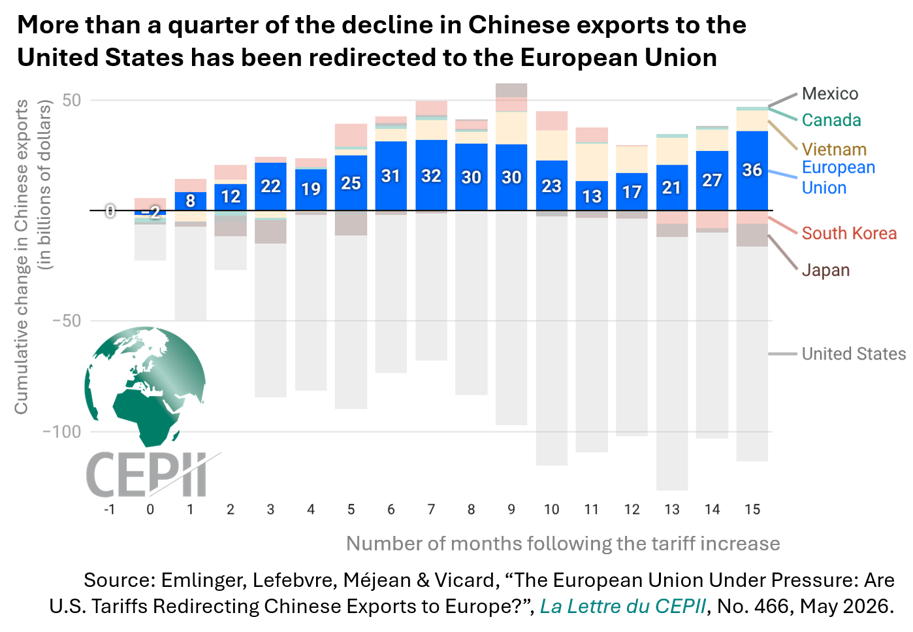 The closure of the U.S. market following Donald Trump’s return to office raises the prospect of a reorientation of Chinese exports toward the European Union. How significant could this shift be? Charlotte Emlinger, Kevin Lefebvre, Isabelle Méjean, Vincent Vicard >>> |
 International Economics is a peer-reviewed journal devoted to the publication of research in the area of applied international economics. The journal especially welcomes empirical contributions that include, but are not limited to, topics in international trade, commercial policy, open economy macroeconomics, international finance, exchange rates, financial and monetary policies, economic development, migration and factor movements. The August 2026 issue is available online, and the October 2026 issue is in progress but contain articles that are final and fully citable. We are very pleased to inform you that International Economics, which is indexed in the Web of Science Core Collection (ESCI), has received its first Clarivate Impact Factor. This inaugural Impact Factor stands at 2.8. In addition, the number of submissions has steadily increased, rising from 127 in 2016 to 657 in 2025. These results reflect the journal's continued growth and increasing visibility within the international academic community. >>> |
To Stay Informed

- Contact us
- Our other sites
 |
 |
 |
ISSN: 1255-7072
Editorial Director : Antoine BouëtManaging Editor : Evgenia Korotkova